It's no surprise that boost is an anagram of boots. Every time I wear the Frida Kahlo boots, bought last winter during a period of mourning, I get a lift. I feel important.
I had a Coat with the same effect (cato?). Though I bought it at C-Mart, you’d never have known; it was made of the most voluptuous cherry-red fur, lined in satin, trimmed with shiny cerise buttons. The label said Saks. The collar stood at attention, and so did everyone I met while wearing The Coat. It kept me warm during Bill Clinton’s first inauguration, where a friend and I upgraded our own seats to Bill Bradley’s section—demurely giggling behind our fingertips and plopping down behind Kim Bassinger and Alec Baldwin, Kathleen Turner, and Jack Nicholson. Photographers cruised the aisles making note of the noteworthy, stopping, always, before me with a certain look that said, “I can’t make you out, but that Coat! You must be someone!”
I was a cherry dot in a Time Magazine centerfold.
Looking important goes a long way toward feeling important. People say if you fake a smile when you're but a pimple on the ass of knowledge, you’ll eventually feel sunny. So it is with The Boots.
I wore them yesterday. I already wore an air of importance; after all, I'd been asked to be on a panel of food writer1 at a conference where Steve Almond was the keynote speaker. When I arrived, a woman held the door for me and referenced The Boots in a loving manner. “I wore them,” I told her, “so that people would compliment me all day long.”
And they did. Everyone—men, women, gods—bowed before my fancy footwear. After the conference, The Boots drove me to the mall and clopped the entire length of the fourth floor, from Crate & Barrel to Nordstrom. People stopped their conversations to gawk. Jaws dropped. Eyes followed The Boots to their vanishing point. I could feel the pull of longing from every young girl in low rise jeans and pierced navel, every old biddy in warmup suit.
The night before the conference, my daughter, husband, and I saw guitar miracle Joe Bonamassa. During the show, Serena had to pee. She'd held it in as long as she could, and, frankly, so had I, but I needed to make her feel responsible for our missing a Bonamassa feat. While we were washing our hands, I explained my rule of audience departure and return: we must head down the aisle between songs. First, it's rude to walk out in the middle of a song. It's like saying, "Sorry, Joe; that tune's piss poor, and I'm piss rich."
But the real reason is this: as you waltz back to your seat, you can pretend all those cheers are for you.
At the Writers' Conference yesterday, I caught up with my old pal Rick Peabody, editor of Gargoyle. A friend once gave him a box of applause. Every so often, he opens the lid and takes a bow.
Few of us ever get to experience the thunder of a thousand cheers. Rock stars. Ball players. The pope. Most of us, if we get any kind of applause at all, get a golf clap. A thank-you clap. Polite hands of mild gratitude. I don't know that I could handle it anyway. I imagine it's like seeing God after a lifetime of disbelief.
I would cry, maybe vomit, and then I'd stop breathing.
1Almost: Henry Hong got locked out and arrived fifteen minutes late.
Sunday, November 13, 2011
Tuesday, November 1, 2011
you're the tops
Topping my list of writing devices is The List. Lists are bare-bones instructions, yet they are also the meat. They are written with an affectionate detachment. They mean everything—and nothing. They are shallow, yet they come from deep within your soul.
In my favorite books are lists of kinds of apples and kinds of orchids, and there is poetry in the arrangement. You keep reading because it sounds like music. My favorite list appears in my number two favorite song of all time:
I recently donated fifty bucks to WTMD. I try to do it every year, even though the radio doesn’t turn me on much. But this year, I tuned in during the station’s fund drive—and its Top 500 Songs of All Time countdown. I gave because I wanted to belong to the club that voted for the Buzzcocks (“Ever Fallen In Love,” #195), even though I’d have to belong to the club that voted for “Free Bird,” too.
But nostalgia is a powerful love maker. There’s a familiarity and warmth that has you singing along with #149, smiling—if you’re of a certain age, of course. The age of our collective consciousness changes the game. It’s why you find songs by Adele and the Black Keys and Mumford and Sons and My Morning Jacket on that list, despite their having zero traction. These songs are someone’s favorites at the moment. How does yesterday’s hit overthrow the song you’ve loved for a whole life? “The Boys are Back in Town,” for instance. “Bennie and the Jets.”
My husband wants to know why we make lists of favorites at all. Who cares but the list maker? We all do! Lists are how you find a compatible mate or friend. Lists remind us who we were, who we have become, and who we still are. They bring back the summer of “Sarah Smile,” when Andrea Palefsky and I fell in love with the same boy on the beach. They remind us of the summer we pretended to love “Kashmir” for a boy—and found we really loved the song but not the boy.
My lists don’t change much. Sometimes my top four films rotate positions, but they are, always, Bladerunner, American Beauty, Lost in Translation, and Fight Club (the newest). Sometimes #5 is Garden State. Sometimes it’s Big Fish. It might even be The Runaways.
Of my top five songs, four did not make it.
My number one song of all time rarely changes. I am, apparently, right.
And while two of my top three musicians did not make the list (to hear him is to love him), the third—the one who makes my monkey dance, the one who put the ram in my rama-lama-ding-dong, was the monkey in the middle, caught at #276.
My friend Kim drove us an hour away to watch him play for only an hour on Saturday night. We talked to him after the show, just as we did the last time—a year ago—and found him, once again, good and kind and interesting. He was also interested. He remembered me and The Book, asked about my recent work.
So—you know. Chuck Prophet "put the bomp in the bomp-shooby-dooby-bomp." He did. He's number one.
In my favorite books are lists of kinds of apples and kinds of orchids, and there is poetry in the arrangement. You keep reading because it sounds like music. My favorite list appears in my number two favorite song of all time:
a bag of dead kittens and mufflers and engines
an army of rats and Colt 45
bottles and tires and shipwrecks and trashcans
a porcelain Jesus, your old Christmas trees
—"It's Only Money, Tyrone," by Marah
I recently donated fifty bucks to WTMD. I try to do it every year, even though the radio doesn’t turn me on much. But this year, I tuned in during the station’s fund drive—and its Top 500 Songs of All Time countdown. I gave because I wanted to belong to the club that voted for the Buzzcocks (“Ever Fallen In Love,” #195), even though I’d have to belong to the club that voted for “Free Bird,” too.
But nostalgia is a powerful love maker. There’s a familiarity and warmth that has you singing along with #149, smiling—if you’re of a certain age, of course. The age of our collective consciousness changes the game. It’s why you find songs by Adele and the Black Keys and Mumford and Sons and My Morning Jacket on that list, despite their having zero traction. These songs are someone’s favorites at the moment. How does yesterday’s hit overthrow the song you’ve loved for a whole life? “The Boys are Back in Town,” for instance. “Bennie and the Jets.”
My husband wants to know why we make lists of favorites at all. Who cares but the list maker? We all do! Lists are how you find a compatible mate or friend. Lists remind us who we were, who we have become, and who we still are. They bring back the summer of “Sarah Smile,” when Andrea Palefsky and I fell in love with the same boy on the beach. They remind us of the summer we pretended to love “Kashmir” for a boy—and found we really loved the song but not the boy.
My lists don’t change much. Sometimes my top four films rotate positions, but they are, always, Bladerunner, American Beauty, Lost in Translation, and Fight Club (the newest). Sometimes #5 is Garden State. Sometimes it’s Big Fish. It might even be The Runaways.
Of my top five songs, four did not make it.
5. “Bennie and the Jets,” Elton John
4. “Young Americans,” David Bowie
3. “The Boys are Back in Town,” Thin Lizzy
2. “It’s Only Money, Tyrone,” Marah
My number one song of all time rarely changes. I am, apparently, right.
And while two of my top three musicians did not make the list (to hear him is to love him), the third—the one who makes my monkey dance, the one who put the ram in my rama-lama-ding-dong, was the monkey in the middle, caught at #276.
My friend Kim drove us an hour away to watch him play for only an hour on Saturday night. We talked to him after the show, just as we did the last time—a year ago—and found him, once again, good and kind and interesting. He was also interested. He remembered me and The Book, asked about my recent work.
So—you know. Chuck Prophet "put the bomp in the bomp-shooby-dooby-bomp." He did. He's number one.
Posted by
fuquinay
at
9:31 AM
10
caws
Labels:
bob schneider,
chuck prophet,
essay,
list,
lists,
marah,
music,
radio,
rock and roll,
top,
top ten,
wtmd
Sunday, September 25, 2011
[solutions]
If you're unhappy with Facebook's changes, don't despair. (Or do, but do it quietly, then take action, then share!) Help is usually a search-engine word or two away.
If you're not browsing in Firefox or Chrome, remedy that right away. Chrome users can install Ad Block Plus, so you won't have to see any more ads in your sidebar. And—wait for it—install The Ticker Hider. (Thanks, Dawn.)
Here are the versions for Firefox: Hide Ticker; Ad Block Plus.
It's also helpful to remember that search engines are pretty sophisticated. If you are looking for the name of the plastic thing on the end of a shoelace, you can simply type in: name of the plastic thing on the end of a shoelace. Ask, and ye shall be answered.
If you're not browsing in Firefox or Chrome, remedy that right away. Chrome users can install Ad Block Plus, so you won't have to see any more ads in your sidebar. And—wait for it—install The Ticker Hider. (Thanks, Dawn.)
Here are the versions for Firefox: Hide Ticker; Ad Block Plus.
It's also helpful to remember that search engines are pretty sophisticated. If you are looking for the name of the plastic thing on the end of a shoelace, you can simply type in: name of the plastic thing on the end of a shoelace. Ask, and ye shall be answered.
Saturday, September 24, 2011
[uproar]
If it’s not mostly quarters, is change just unnecessary weight and an unsatisfying jangle?
We’re used to doing the things we do the way we always do them. We’re efficient—and complacent—that way. Most of us don’t even rearrange our furniture or get an entirely new hairstyle, despite all the evidence that change does our brains and our bodies good. Something as simple as driving a different way every so often can keep our minds from lapsing into forgetfulness, and the muscle confusion that comes from changing workout routines is encouraged by fitness gurus. We can even suffer from a phenomenon known as taste fatigue when we eat the same things all the time. (I rotate my ales regularly.)
But this uproar over the latest round of Facebook changes?
In all these years, all that Facebook stuff—all the networking and friendship and rekindling of old flames and sharing of videos and photos, all the love and support, all the drunken midnight status updating and the PopCap games—is still free. So if you quit in a mostly unnoticed protest over what you may mistakenly believe is yet another invasion of your privacy, understand that you miss more than LOLCATS and vomiting pumpkins and bad grammar.
Here’s the real problem, the real reason you are aggravated. You’ve been on Facebook for more than a year, and you still don’t know how to use it. You have a useful tool in your hands, but it might as well be a weapon. You post but don’t assume responsibility for the things you say, to whom.1 You can’t tell the difference between spam and porn, and your desire for the latter by clicking the former leads to an embarrassing tell. We’ve all made the mistake, but so many of you don’t know what to do about it immediately to make it go away.
Like VCRs, Facebook is not intuitive. You need to read the directions or “take the tour.” But most people don’t want to stop for a few minutes to peek at privacy settings, organize contacts, disable applications. You actually do have a right to complain about the president if you don’t vote. But how can you complain that the posts you make available to all your friends suddenly show up on a feed where all your friends can see it? Especially since the first time you complained about Facebook’s changes, it was because you didn’t see enough of your friends’ updates?!
One of the first privacy-related things I did when I joined Facebook was put my friends into categories. From day one, from the first friend I got, I started lists of people—NOGLI for people in my neighborhood; Homies for people who live in town; School of Rock kids and School of Rock parents. I have a category called “Anything Goes” populated by folks I know won’t mind my politics, my bawdy sense of humor, my cussing, my issues. When I post things that aren’t appropriate for kids, I exclude them for only those posts. I turn off my wall for people in the category called “People I Don’t Really Know.”
A few weeks ago, a social media expert was talking about the new “lists” feature developed to compete with Google+'s circles. I said, “New? Facebook has always had lists!” He was incredulous. Even the experts don't know how to use the medium!
Some remarkable things have happened to me through Facebook. I sold scarves when I had back surgery, so I could afford an expensive red leather electric recliner. I got a lot of freelance work. I sold photographs. I got people to come out to Serena’s gigs and my poetry readings. I found old friends and made a hundred new ones. I fraternized with rock stars (one of them even made my photo his profile picture today!) and shared sunsets and songs and knowledge and jokes, good and bad, with everyone I know or almost know.
And yes: I share. You could call me an over-sharer, but don’t. I am a nonfiction writer and a poet, with all the eccentricities those titles bring. Plunk me down in a land called Facebook, and I am at home. Responding to me with a “TMI” or an un-friending is like bitching about drunk people in a bar. Some people have a drink or two. Some are the designated drivers. Some get tipsy. And some just need to kill the pain of the shit of their lives. Most of us have been all those people at some time.
Deal with them—with us—compassionately. Even on Facebook.
And quit yer whining about it.
1A few months ago during a political scandal, my husband, a teacher of social studies (which includes politics and current events), stuffed his bike shorts with about twenty pairs of socks, poking fun at Anthony Weiner. It was an effort to make me laugh, something I was doing with less frequency after the lymphoma diagnoses (my dad’s and mine). I posted this photo on my Facebook page—invisible to kids, despite it being harmless—because it was the funniest thing I’d seen in weeks
Though I have but a handful of school affiliates as friends on Facebook, someone reported me to the boss. My guess is it’s someone who doesn’t know how to use Facebook, someone who didn’t realize that I’d had the good sense to restrict the photo’s visibility. I sent them all an email explaining why I had to remove them from my page.
While I do take responsibility for the things I post, I ask my Facebook friends to take responsibility for friendship. If you come across a questionable post, an email or a phone call works much better than being a tattletale.
We’re used to doing the things we do the way we always do them. We’re efficient—and complacent—that way. Most of us don’t even rearrange our furniture or get an entirely new hairstyle, despite all the evidence that change does our brains and our bodies good. Something as simple as driving a different way every so often can keep our minds from lapsing into forgetfulness, and the muscle confusion that comes from changing workout routines is encouraged by fitness gurus. We can even suffer from a phenomenon known as taste fatigue when we eat the same things all the time. (I rotate my ales regularly.)
But this uproar over the latest round of Facebook changes?
In all these years, all that Facebook stuff—all the networking and friendship and rekindling of old flames and sharing of videos and photos, all the love and support, all the drunken midnight status updating and the PopCap games—is still free. So if you quit in a mostly unnoticed protest over what you may mistakenly believe is yet another invasion of your privacy, understand that you miss more than LOLCATS and vomiting pumpkins and bad grammar.
Here’s the real problem, the real reason you are aggravated. You’ve been on Facebook for more than a year, and you still don’t know how to use it. You have a useful tool in your hands, but it might as well be a weapon. You post but don’t assume responsibility for the things you say, to whom.1 You can’t tell the difference between spam and porn, and your desire for the latter by clicking the former leads to an embarrassing tell. We’ve all made the mistake, but so many of you don’t know what to do about it immediately to make it go away.
Like VCRs, Facebook is not intuitive. You need to read the directions or “take the tour.” But most people don’t want to stop for a few minutes to peek at privacy settings, organize contacts, disable applications. You actually do have a right to complain about the president if you don’t vote. But how can you complain that the posts you make available to all your friends suddenly show up on a feed where all your friends can see it? Especially since the first time you complained about Facebook’s changes, it was because you didn’t see enough of your friends’ updates?!
One of the first privacy-related things I did when I joined Facebook was put my friends into categories. From day one, from the first friend I got, I started lists of people—NOGLI for people in my neighborhood; Homies for people who live in town; School of Rock kids and School of Rock parents. I have a category called “Anything Goes” populated by folks I know won’t mind my politics, my bawdy sense of humor, my cussing, my issues. When I post things that aren’t appropriate for kids, I exclude them for only those posts. I turn off my wall for people in the category called “People I Don’t Really Know.”
A few weeks ago, a social media expert was talking about the new “lists” feature developed to compete with Google+'s circles. I said, “New? Facebook has always had lists!” He was incredulous. Even the experts don't know how to use the medium!
Some remarkable things have happened to me through Facebook. I sold scarves when I had back surgery, so I could afford an expensive red leather electric recliner. I got a lot of freelance work. I sold photographs. I got people to come out to Serena’s gigs and my poetry readings. I found old friends and made a hundred new ones. I fraternized with rock stars (one of them even made my photo his profile picture today!) and shared sunsets and songs and knowledge and jokes, good and bad, with everyone I know or almost know.
And yes: I share. You could call me an over-sharer, but don’t. I am a nonfiction writer and a poet, with all the eccentricities those titles bring. Plunk me down in a land called Facebook, and I am at home. Responding to me with a “TMI” or an un-friending is like bitching about drunk people in a bar. Some people have a drink or two. Some are the designated drivers. Some get tipsy. And some just need to kill the pain of the shit of their lives. Most of us have been all those people at some time.
Deal with them—with us—compassionately. Even on Facebook.
And quit yer whining about it.
1A few months ago during a political scandal, my husband, a teacher of social studies (which includes politics and current events), stuffed his bike shorts with about twenty pairs of socks, poking fun at Anthony Weiner. It was an effort to make me laugh, something I was doing with less frequency after the lymphoma diagnoses (my dad’s and mine). I posted this photo on my Facebook page—invisible to kids, despite it being harmless—because it was the funniest thing I’d seen in weeks
Though I have but a handful of school affiliates as friends on Facebook, someone reported me to the boss. My guess is it’s someone who doesn’t know how to use Facebook, someone who didn’t realize that I’d had the good sense to restrict the photo’s visibility. I sent them all an email explaining why I had to remove them from my page.
While I do take responsibility for the things I post, I ask my Facebook friends to take responsibility for friendship. If you come across a questionable post, an email or a phone call works much better than being a tattletale.
Sunday, September 11, 2011
a bouquet of words—with a stamp: an open letter to jon stewart
Dear Jon Stewart,
Mock all you want, but Senator Claire McCaskill is right.
While, as the Jewish mother of a 13-year-old girl, I applaud McCaskill's public calling out of her daughters, I defend her today as an advocate for good English and the preservation of delight. Yes, both at the same time.
You can chuckle at that, like you chuckled at McCaskill's idea of a marketing campaign. But sometimes the positive result of money spent is not merely money gained.
When I stopped teaching college English in 2007 to write a book (published by Simon & Schuster in 2009—shameless plug), students were already losing their memories to Google and their spelling and punctuation skills to texting and emailing. I considered it my job, especially as an instructor of "ideas in writing," my course title, to teach students how to get noticed by writing fucking brilliant letters—letters of introduction, of complaint, of thanks, and, most important, of compliment.
People—strangers, even—tell you they love you every day. (By the way, Jon, I love you.) But imagine how wonderful it is for a customer service representative to open a letter—even an email—that says, "You are doing a great job! I love my [Page Nibs from Levenger]! And they were delivered the next day! I don't know how I lived without these little metal miracles. And you. Thank you."
The rep who received a letter similar to that one sent me a reply, saying that the CSRs passed it around the office as a reminder that they do things right sometimes, because all they ever hear are complaints. It made them happy! The owner of the company sent me a copy of his book, signed, as thanks for my thanks!
With well-written letters, I've gotten free Ray Bans and coupons for favorite foods. I've gotten replies from rock stars. Imagine being a fifteen-year-old girl (yeah, go ahead and imagine that!) and exchanging letters with Cheap Trick's Rick Nielsen! Or getting a letter in the mail from Patti Smith's bassist, Ivan Kral, or from actress Melissa Leo, or from Jane Siberry—or anyone you admire.
Perhaps even better: imagine getting a card for every holiday, occasion, or mental breakdown you celebrate. (My friend Derek does that.) My friend Lysandra sends me chocolates from Hawaii when I'm feeling down, and Monica sends thoughtful goodies to say she's thinking of me. When I had back surgery, I received cards, letters, and packages from all over the world. I might have died without those letters. They meant more to me than blog replies and emails because people had to make extra effort to get in touch.
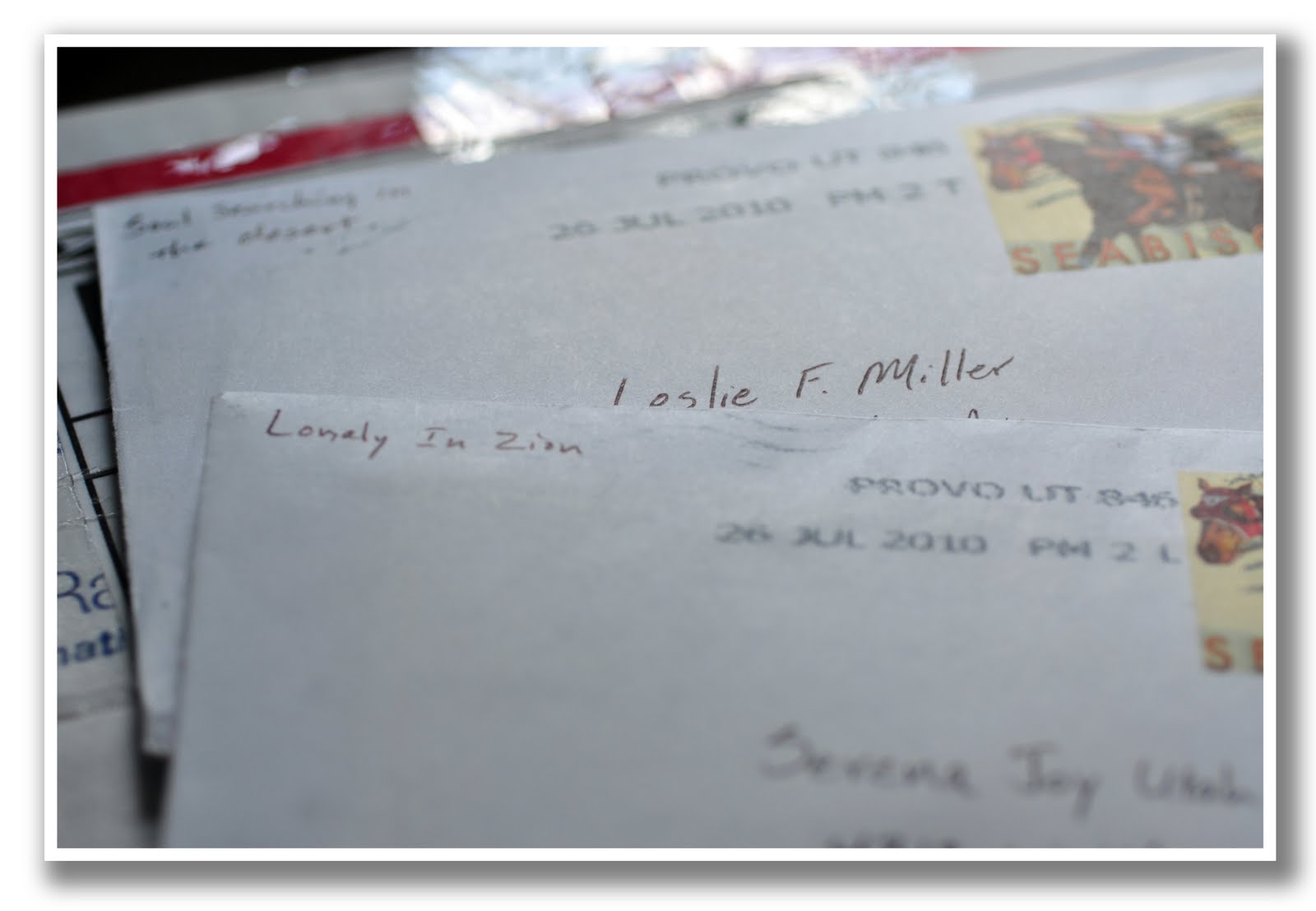
Last year, my husband went camping by himself and wrote me and our daughter several letters from Utah. Those letters were bouquets of words, jewels. We anticipated them and went to the mailbox, hopefully1, every day. I wrote about it on my blog, and it inspired others to send letters.
A marketing campaign to encourage people to write more letters is like a marketing campaign to keep people from smoking. It's a public service. Letters—writing them, receiving them—make you healthy. They improve your vocabulary, your attention to detail, your memory, and your appreciation. They slow you down. They teach you how important your words can be and how to choose them wisely. And, unlike an essay you write in high school or college, the outcome is personal. (And you can get free stuff.)
Even if you send the letter as an email, without buying a stamp from the post office, the very act of writing a letter, as opposed to emailing someone, has improved our current state of grammatical affairs.
Letters of thanks and appreciation, annual New Years catch-up letters sent to the whole slue of family and friends, love letters—those are worth the wait. It's too easy when you're angry to pop off a nasty email; Send is commanding and irreversible. But an angry letter? By the time you print it, reread it, address an envelope, and stamp it, you've cooled down. That letter on the counter, waiting to be mailed, could be insignificant by morning. In the end, you get to keep your friend.
That's just a little of what a marketing campaign could do. It can teach us that letters are more than IDK, OMG, and WTF. It can help us regain our thoughtfulness and our intelligence and our beauty. Forget about saving the job of the nasty pink-haired biddy at your neighborhood post office. The mail is not about her. It is in spite of her.
One week after September 11, the anthrax attacks began. People took potholders and oven mitts with them to retrieve the mail. Companies stopped accepting letters, and employees in mail rooms and post offices had to wear protective gear before opening letters. Our refusal to send or receive mail is partially responsible for the post office's collapse; it's another way the terrorists win—and the government continues to erode our freedoms.
Our mailboxes should be shrines—full of thanks and love letters and beautiful magazines and the occasional flyer from the local Chinese joint, all misspelled for laughs. I'd say that bills, jury duty notices, work, and things that require immediate attention should come by email, but what about those who don't have computers or email access? These things are still a luxury for so many Americans. But mail comes to everyone.
So, while this letter, which took nearly an hour to compose on a Sunday morning (even longer to proofread and edit), will appear on my blog (with pictures and links), it will also get a 44-cent stamp and come to you in the mail.
It will also say: Thank you, Jon Stewart, for your common sense and decency and wicked humor and honesty.
With admiration and affection,
Leslie
1 Note the correct use of hopefully.
Mock all you want, but Senator Claire McCaskill is right.
While, as the Jewish mother of a 13-year-old girl, I applaud McCaskill's public calling out of her daughters, I defend her today as an advocate for good English and the preservation of delight. Yes, both at the same time.
You can chuckle at that, like you chuckled at McCaskill's idea of a marketing campaign. But sometimes the positive result of money spent is not merely money gained.
When I stopped teaching college English in 2007 to write a book (published by Simon & Schuster in 2009—shameless plug), students were already losing their memories to Google and their spelling and punctuation skills to texting and emailing. I considered it my job, especially as an instructor of "ideas in writing," my course title, to teach students how to get noticed by writing fucking brilliant letters—letters of introduction, of complaint, of thanks, and, most important, of compliment.
People—strangers, even—tell you they love you every day. (By the way, Jon, I love you.) But imagine how wonderful it is for a customer service representative to open a letter—even an email—that says, "You are doing a great job! I love my [Page Nibs from Levenger]! And they were delivered the next day! I don't know how I lived without these little metal miracles. And you. Thank you."
The rep who received a letter similar to that one sent me a reply, saying that the CSRs passed it around the office as a reminder that they do things right sometimes, because all they ever hear are complaints. It made them happy! The owner of the company sent me a copy of his book, signed, as thanks for my thanks!
With well-written letters, I've gotten free Ray Bans and coupons for favorite foods. I've gotten replies from rock stars. Imagine being a fifteen-year-old girl (yeah, go ahead and imagine that!) and exchanging letters with Cheap Trick's Rick Nielsen! Or getting a letter in the mail from Patti Smith's bassist, Ivan Kral, or from actress Melissa Leo, or from Jane Siberry—or anyone you admire.
Perhaps even better: imagine getting a card for every holiday, occasion, or mental breakdown you celebrate. (My friend Derek does that.) My friend Lysandra sends me chocolates from Hawaii when I'm feeling down, and Monica sends thoughtful goodies to say she's thinking of me. When I had back surgery, I received cards, letters, and packages from all over the world. I might have died without those letters. They meant more to me than blog replies and emails because people had to make extra effort to get in touch.
Last year, my husband went camping by himself and wrote me and our daughter several letters from Utah. Those letters were bouquets of words, jewels. We anticipated them and went to the mailbox, hopefully1, every day. I wrote about it on my blog, and it inspired others to send letters.
A marketing campaign to encourage people to write more letters is like a marketing campaign to keep people from smoking. It's a public service. Letters—writing them, receiving them—make you healthy. They improve your vocabulary, your attention to detail, your memory, and your appreciation. They slow you down. They teach you how important your words can be and how to choose them wisely. And, unlike an essay you write in high school or college, the outcome is personal. (And you can get free stuff.)
Even if you send the letter as an email, without buying a stamp from the post office, the very act of writing a letter, as opposed to emailing someone, has improved our current state of grammatical affairs.
Letters of thanks and appreciation, annual New Years catch-up letters sent to the whole slue of family and friends, love letters—those are worth the wait. It's too easy when you're angry to pop off a nasty email; Send is commanding and irreversible. But an angry letter? By the time you print it, reread it, address an envelope, and stamp it, you've cooled down. That letter on the counter, waiting to be mailed, could be insignificant by morning. In the end, you get to keep your friend.
That's just a little of what a marketing campaign could do. It can teach us that letters are more than IDK, OMG, and WTF. It can help us regain our thoughtfulness and our intelligence and our beauty. Forget about saving the job of the nasty pink-haired biddy at your neighborhood post office. The mail is not about her. It is in spite of her.
One week after September 11, the anthrax attacks began. People took potholders and oven mitts with them to retrieve the mail. Companies stopped accepting letters, and employees in mail rooms and post offices had to wear protective gear before opening letters. Our refusal to send or receive mail is partially responsible for the post office's collapse; it's another way the terrorists win—and the government continues to erode our freedoms.
Our mailboxes should be shrines—full of thanks and love letters and beautiful magazines and the occasional flyer from the local Chinese joint, all misspelled for laughs. I'd say that bills, jury duty notices, work, and things that require immediate attention should come by email, but what about those who don't have computers or email access? These things are still a luxury for so many Americans. But mail comes to everyone.
So, while this letter, which took nearly an hour to compose on a Sunday morning (even longer to proofread and edit), will appear on my blog (with pictures and links), it will also get a 44-cent stamp and come to you in the mail.
It will also say: Thank you, Jon Stewart, for your common sense and decency and wicked humor and honesty.
With admiration and affection,
Leslie
1 Note the correct use of hopefully.
Wednesday, August 17, 2011
beer, luxurious beer: what aleth thee?
The other day, my friend Bruce posted this funny-but-true joke on my wall:
So when The Daily Post asked for the one luxury I refuse to live without, the hops that spring eternal sprang to mind.
But my whole life is luxurious. I have not just one computer, but three—a big Mac and two Macbook Pros (one is a work issue). I have an iPhone, a bunch of TVs, appliances. I have window air conditioners, a green-emissions SUV, and don’t get me started on the guitars. Guitars for backpacking and sitting in the kitchen and plugging in and turning up loud.
Gabi thinks our technologies aren’t luxuries—to us. She says we all have those, so we should keep that in perspective. After all, she doesn’t indulge in other luxuries: cars, dinners in restaurants, meat.
But where I live, technology is still a luxury. The buses are crowded with people who don’t drive because they can’t afford cars, and people are robbed for their cell phones. In fact, being a vegetarian—getting to eschew readily available foods in preference for others—is one of the greatest luxuries of all.
When my husband worked as a GED teacher at a school for at-risk youth (a misnomer; they’d already lost), we both saw a good deal of poverty. We lived in a raggedy rowhouse then and were pretty poor ourselves. But not by comparison.
I recognize that now. My whole life is luxurious. A nightly bath in a tub of clean water in a semi-clean bathroom is decadent. A piece of chocolate is heavenly. My job, my paprika-orange ride. But the one thing, the only thing (not person, not animal family) that makes coping with the other shit of life worthwhile, to me, is some bitter, sharp, tasty, hoppy, hopeful ale—preferably Resurrection or Dead Guy or Flying Dog variety. It’s my coping mechanism. It’s my go-to gulp, my heart mender, my mind bender. Even when I was making nothing, I was drinking something amazing.
And while I recognize that nearly everything in my life—from my cracked tile floor and leaking toilets to my pot of chili on the stove and two well-fed dogs—is luxurious, I don’t apologize for having any of it.
Instead, I share.
Leslie was drinking a glass of beer while outside with her husband, Marty.
Leslie said, “I love you so much! I don’t know how I could ever live without you.”
Marty asked, “Is that you or the beer talking?”
Leslie replied, “It’s me—talking to the beer, of course.”
So when The Daily Post asked for the one luxury I refuse to live without, the hops that spring eternal sprang to mind.
But my whole life is luxurious. I have not just one computer, but three—a big Mac and two Macbook Pros (one is a work issue). I have an iPhone, a bunch of TVs, appliances. I have window air conditioners, a green-emissions SUV, and don’t get me started on the guitars. Guitars for backpacking and sitting in the kitchen and plugging in and turning up loud.
Gabi thinks our technologies aren’t luxuries—to us. She says we all have those, so we should keep that in perspective. After all, she doesn’t indulge in other luxuries: cars, dinners in restaurants, meat.
But where I live, technology is still a luxury. The buses are crowded with people who don’t drive because they can’t afford cars, and people are robbed for their cell phones. In fact, being a vegetarian—getting to eschew readily available foods in preference for others—is one of the greatest luxuries of all.
When my husband worked as a GED teacher at a school for at-risk youth (a misnomer; they’d already lost), we both saw a good deal of poverty. We lived in a raggedy rowhouse then and were pretty poor ourselves. But not by comparison.
I recognize that now. My whole life is luxurious. A nightly bath in a tub of clean water in a semi-clean bathroom is decadent. A piece of chocolate is heavenly. My job, my paprika-orange ride. But the one thing, the only thing (not person, not animal family) that makes coping with the other shit of life worthwhile, to me, is some bitter, sharp, tasty, hoppy, hopeful ale—preferably Resurrection or Dead Guy or Flying Dog variety. It’s my coping mechanism. It’s my go-to gulp, my heart mender, my mind bender. Even when I was making nothing, I was drinking something amazing.
And while I recognize that nearly everything in my life—from my cracked tile floor and leaking toilets to my pot of chili on the stove and two well-fed dogs—is luxurious, I don’t apologize for having any of it.
Instead, I share.
Tuesday, June 21, 2011
A Challenging June
On June 2, I had nine biopsies of some enlarged lymph nodes in my mesentery (that's the "double layer of peritoneum that suspends the jejunum and ileum from the posterior wall of the abdomen," which, I'm certain, gives you a clear picture). I don't think my jejunum and ileum are in danger, but my peritoneum was less lucky. I have lymphoma.
I have lymphoma. I have lymphoma. Lymphoma. Lymmmmm-phoooooo-muhhhhhhh. I say that over and over again. It's low-grade, B-cell lymphoma, which means that it originates in the bone and will grow slowly, and I'll go into remission, but it won't die. It probably won't kill me, either. Yet when I say lymphoma, it still sounds like cancer.
Cancer should be a beautiful thing. It rhymes with Dancer and Prancer—happy reindeer. It rhymes with romancer. My dog, Chancer. And though it also rhymes with answer, I have nothing but questions.
When I was first diagnosed, I did not look on the Internet for information except for the one time I saw that the median survival was ten to fifteen years. I've spoken about it on Facebook. I mention it in conversation. I use it, sometimes, to explain my tears over simple things like getting an IV stick before a colonoscopy. And everywhere I say it, someone tells me his uncle or her grandmother—or, as in the case of the nurse nervously spilling my blood in her second attempt at an IV stick, her daughter—has lymphoma, and he/she has never been treated or is ninety-five or is in remission or is under the care of my own doctor.
Today, I am awaiting the results of my endoscopy/colonoscopy biopsies. Next week, I will have my bone marrow tested. Because I have a stomachache, I will need some sort of treatment, most likely with an antigen—a four-hour weekly infusion. It is not supposed to have side effects, according to my doctor, but it does. (He also says the bone marrow test doesn't hurt, but having Novocaine injected on either side of your spine, then more into your bones, then having the marrow extracted is likely more unpleasant than most things I can think of. So I try not to think of it.)
I am grateful to have had some good care at Good Samaritan Hospital, where I went not for the primary symptom of a stomachache but for a prescription for Nitroglycerine, in case I ever get another episode of the family curse: a spastic esophagus. Before I was to leave the hospital that day in March, the doctor examined me and feared I had appendicitis. I was in tears because I was just about to take my daughter to see Bob Schneider in concert for her first time. The results—nothing wrong in my organs but enlarged lymph nodes that would need to be rescanned in six weeks—weren't particularly scary. Food poisoning or a virus seemed reasonable; lymphoma did not. Nearly all of these discoveries of lymphoma (lymmmm-phooooo-muhhhhhh, lymphoma, cancer) are accidental.
I am also grateful to Dr. Marc Gertner for taking such excellent care of me, for leading me to believe I have a good attitude, for treating me like he would a person he cares about. And to my family for their kindness and patience and money (insurance is denying everything, naturally). And a special thank you to my friends for thinking of me, checking up on me, for letting me cry and vent and be selfish. Thanks for all the cards and messages and homemade foods and offers of financial aid in the form of rock benefits and all the other niceties that somehow seem to rain down on me when I need them most.
But I am uncomfortable needing them. That has made this month even more of a challenge—as have a new car payment and job interviews. Still, I'm plugging away, getting my work done, writing for Baltimore Fishbowl, watching my daughter's musical talent explode. Songs, new and old, are still being sung. Photographs are still being taken. The beer is still being drunk. This life is still being lived.
*That's my girl on drums!
I have lymphoma. I have lymphoma. Lymphoma. Lymmmmm-phoooooo-muhhhhhhh. I say that over and over again. It's low-grade, B-cell lymphoma, which means that it originates in the bone and will grow slowly, and I'll go into remission, but it won't die. It probably won't kill me, either. Yet when I say lymphoma, it still sounds like cancer.
Cancer should be a beautiful thing. It rhymes with Dancer and Prancer—happy reindeer. It rhymes with romancer. My dog, Chancer. And though it also rhymes with answer, I have nothing but questions.
When I was first diagnosed, I did not look on the Internet for information except for the one time I saw that the median survival was ten to fifteen years. I've spoken about it on Facebook. I mention it in conversation. I use it, sometimes, to explain my tears over simple things like getting an IV stick before a colonoscopy. And everywhere I say it, someone tells me his uncle or her grandmother—or, as in the case of the nurse nervously spilling my blood in her second attempt at an IV stick, her daughter—has lymphoma, and he/she has never been treated or is ninety-five or is in remission or is under the care of my own doctor.
Today, I am awaiting the results of my endoscopy/colonoscopy biopsies. Next week, I will have my bone marrow tested. Because I have a stomachache, I will need some sort of treatment, most likely with an antigen—a four-hour weekly infusion. It is not supposed to have side effects, according to my doctor, but it does. (He also says the bone marrow test doesn't hurt, but having Novocaine injected on either side of your spine, then more into your bones, then having the marrow extracted is likely more unpleasant than most things I can think of. So I try not to think of it.)
I am grateful to have had some good care at Good Samaritan Hospital, where I went not for the primary symptom of a stomachache but for a prescription for Nitroglycerine, in case I ever get another episode of the family curse: a spastic esophagus. Before I was to leave the hospital that day in March, the doctor examined me and feared I had appendicitis. I was in tears because I was just about to take my daughter to see Bob Schneider in concert for her first time. The results—nothing wrong in my organs but enlarged lymph nodes that would need to be rescanned in six weeks—weren't particularly scary. Food poisoning or a virus seemed reasonable; lymphoma did not. Nearly all of these discoveries of lymphoma (lymmmm-phooooo-muhhhhhh, lymphoma, cancer) are accidental.
I am also grateful to Dr. Marc Gertner for taking such excellent care of me, for leading me to believe I have a good attitude, for treating me like he would a person he cares about. And to my family for their kindness and patience and money (insurance is denying everything, naturally). And a special thank you to my friends for thinking of me, checking up on me, for letting me cry and vent and be selfish. Thanks for all the cards and messages and homemade foods and offers of financial aid in the form of rock benefits and all the other niceties that somehow seem to rain down on me when I need them most.
But I am uncomfortable needing them. That has made this month even more of a challenge—as have a new car payment and job interviews. Still, I'm plugging away, getting my work done, writing for Baltimore Fishbowl, watching my daughter's musical talent explode. Songs, new and old, are still being sung. Photographs are still being taken. The beer is still being drunk. This life is still being lived.
*That's my girl on drums!
Subscribe to:
Posts (Atom)